UETDRMP018 — Perform rescue from a live low voltage panel
Low voltage electrical panel rescue training — safely removing a person in contact with a live LV panel without electrocuting yourself or bystanders.
Course Overview
This unit involves the skills and knowledge required to perform a rescue from live low voltage (LV) electrical apparatus in an electrical industry environment. This does not include overhead lines and underground cables.
It includes the organisational workplace requirements for the inspection and use of live LV panel rescue equipment, and how it applies to electricity supply industry (ESI) workers and/or electrical industry workers to meet work health and safety (WHS)/occupational health and safety (OHS), mobility and mutual aid requirements.
View UETDRMP018 on training.gov.au →UETDRMP018 Perform rescue from a live low voltage panel is a specialised emergency response course that trains workers to safely remove a person who is in contact with a live low-voltage (LV) electrical panel or circuit — without becoming a second victim. Electrocution rescues are among the most dangerous and instinctive-response situations a worker can face; this course replaces panic-driven actions with correct, controlled techniques that protect both the rescuer and the casualty.
Required for electrical workers, emergency response team (ERT) members and workers on high-voltage or industrial electrical sites throughout Queensland, this half-day course is often combined with HLTAID009 or HLTAID011 to provide a complete electrical emergency response capability.
What You'll Learn
- Understand the physiological effects of low-voltage electric shock on the human body
- Recognise a live LV panel contact situation and assess the scene safely without touching the casualty
- Identify the preferred method — isolating the supply — and the location of the main isolator or switchboard
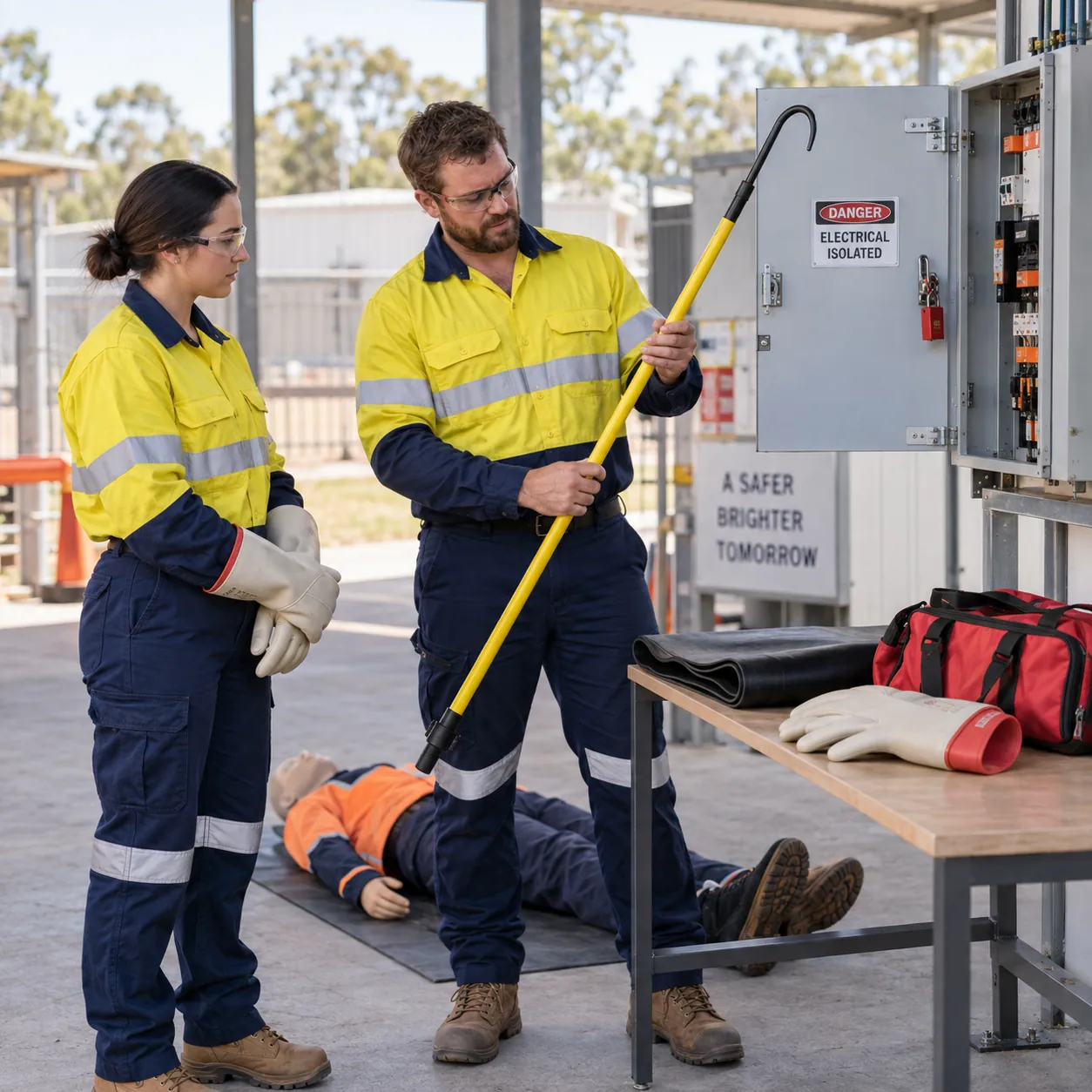
- Use approved non-conductive rescue tools (wooden stick, rubber gloves, dry rope) to break contact when isolation is not immediately possible
- Apply safe step potential and touch potential awareness when moving in and around the scene
- Manage the casualty after removal, including assessing for cardiac arrest and initiating CPR with AED
- Document the incident and preserve the scene for electrical safety investigation
Assessment Method
Assessment includes a practical rescue scenario demonstration (using a training mock-up LV panel), a CPR and AED sequence, and a written knowledge assessment covering electrical hazards, isolation principles and scene management. All assessment is completed at our Dalby facility on the training day.
Prerequisites
Current HLTAID009 CPR or HLTAID011 First Aid is required (or completed on the same day). Participants must be physically capable of performing CPR.
Who Should Attend
- Electricians, electrical apprentices and electrical trades workers in Queensland
- Emergency response team (ERT) members on industrial, mining and processing sites
- Workers in manufacturing, utilities and pumping station environments
- Site supervisors and safety officers with responsibility for electrical emergency planning
- First aid officers in facilities where LV electrical panels are present and regularly worked on